SQShowSquad
CalendarSign inJoin
The Universe
RELEASED·SERIES·EN

The Universe

Tue, May 29, 2007
  • Documentary
Series · Synopsis

Synopsis

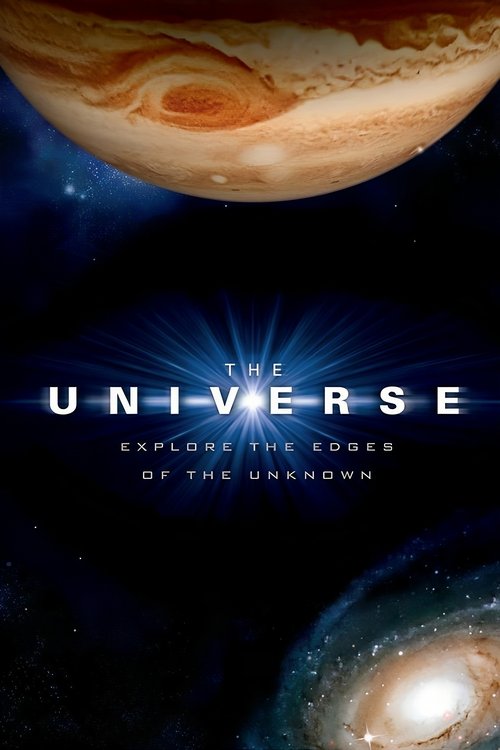
From the planets to the stars and out to the edge of the unknown, history and science collide in a wondrous yet deadly adventure through space and time.

Where to watch

Streaming on

  • Amazon Prime Video↗
  • Philo↗
  • HISTORY Vault Apple TV Channel↗
  • HISTORY Vault Amazon Channel↗
  • Amazon Prime Video with Ads↗
  • History↗
Cast

Top of the call sheet

  • David Ackroyd
    David Ackroyd
    as —
  • Erik Thompson
    Erik Thompson
    as —
Related

If you’re into this…

  • Horizon
    Horizon
    1964 · series
  • Cosmos: A Personal Voyage
    Cosmos: A Personal Voyage
    1980 · series
  • The Ark
    The Ark
    2023 · series
  • The Planets
    The Planets
    1999 · series
  • The Planets
    The Planets
    2019 · series
  • Cosmos
    Cosmos
    2014 · series
  • Stargate SG-1
    Stargate SG-1
    1997 · series
  • The World According to Jeff Goldblum
    The World According to Jeff Goldblum
    2019 · series
  • Star Trek: Short Treks
    Star Trek: Short Treks
    2018 · series
  • Universe
    Universe
    2021 · series
SQShowSquad
CalendarSign inJoin
Episodes

9 seasons · 88 episodes

Ended · 88 aired
Season 1
14 episodes · 14 aired
▾
  • E1
    Secrets of the Sun
    Aired · Wed, May 30, 2007 · 60m

    Behold the sun and all of it's glory. Learn all things about the sun ranging from its beginning to its death. Also learn about how stars work in general and MUCH MUCH more.

  • E2
    Mars: The Red Planet
    Aired · Wed, Jun 6, 2007 · 60m

    Visit the planet most like Earth. There is a discussion of what life on Mars would be like and about the life forms that could've evolved there.

  • E3
    The End of the Earth: Deep Space Threats to Our Planet
    Aired · Wed, Jun 13, 2007 · 60m

    Asteroids, comets, gamma ray bursts and the sun all combine to make the Earth a dangerous place to live. NASA's top brass and other scientists are arming themselves with the latest technology to pre-empt an apocalyptic attack. Watch and investigate bizarre, and terrifying apocalyptic scenarios and the ways that scientists are racing against the clock to develop technology to defend our planet.

  • E4
    Jupiter: The Giant Planet
    Aired · Wed, Jun 20, 2007 · 60m

    Jupiter poses many questions about our solar system. It is a powerful planet of gas whose flowing colors and spots are beautiful, but contain violent storms and jet streams. A mini solar system of over sixty moons rotate around Jupiter--a half billion miles from earth. Could one of these moons contain life under its icy crust?

  • E5
    The Moon
    Aired · Wed, Jun 27, 2007 · 60m

    The moon has comforted man for thousands of years. It's been everything from a god to a compass, and the only cosmic body human beings have ever visited. NASA is planning to build a permanent outpost there. Discover how the moon came to be--if you don't already know, you will be astounded.

  • E6
    Spaceship Earth
    Aired · Wed, Jul 11, 2007 · 60m

    Take a high performance ride through the formation of the third planet from the Sun, Earth... A survivor of one of the most violent "neighborhoods" in the Universe, learn how Earth was created and discover what creatures hold clues to how life began. What evil forces threaten the demise of Earth? Complex and controversial, this is the scientific detective story of all time.

  • E7
    The Inner Planets: Mercury & Venus
    Aired · Wed, Jul 18, 2007 · 60m

    Examining Mercury and Venus. Included: exploring how the damages they've suffered from cosmic collisions and acid rain may serve as a warning for Earth.

  • E8
    Saturn: Lord of the Rings
    Aired · Wed, Jul 25, 2007 · 60m

    Are the rings of Saturn a real celestial phenomenon or merely a cosmic Illusion? Technology allows the experts to get closer to the furthest planet visible to the naked eye. Old questions are answered and new ones arise. Does Saturn hold the key to Earth's weather and will one of its moons supply us with all the oil we'll ever need?

  • E9
    Alien Galaxies
    Aired · Wed, Aug 1, 2007 · 60m

    Our galaxy is one of hundreds of billions in the universe. View of universe through the Hubble telescope and go back almost all the way to the Big Bang.

  • E10
    Life and Death of a Star
    Aired · Wed, Aug 8, 2007 · 60m

    Ignited by the power of the atom, burning with light, heat and wrath, stars are anything but peaceful. They collide, devour each other, and explode in enormous supernovas--the biggest explosions in the Universe.

  • E11
    The Outer Planets
    Aired · Wed, Aug 15, 2007 · 60m

    This episode details outer lying planets and their moons. Included will be Uranus, Neptune, and Pluto. Using CGI, we will also see what alien life might look like on other worlds.

  • E12
    The Most Dangerous Place in the Universe
    Aired · Wed, Aug 22, 2007 · 60m

    Take a tour of the cosmic hot zones--black holes, galaxy mergers, gamma ray bursts and magnetars. Super black holes can literally lasso Earth out of the solar system. A clash between two galaxies can result in a ritual called galactic cannibalism. Magnetars are a cosmic magnetic force so strong it could wipe out data on every credit card.

  • E13
    Search for ET
    Aired · Wed, Aug 29, 2007 · 60m

    Are we alone? SETI--the Search for Extraterrestrial Intelligence--is a privately funded project using radio telescopes and optical telescopes to scan the stars for signals.

  • E14
    Beyond the Big Bang
    Aired · Wed, Sep 5, 2007 · 60m

    The universe began with a massive expansion, billions and billions of years ago, and it continues to expand with every passing second. The idea that the universe, and man's very existence, began with a "Big Bang" is no longer a topic of debate among most scientists--it is essentially taken as fact.

Season 2
18 episodes · 18 aired
▾
  • E1
    Alien Planets
    Aired · Wed, Nov 28, 2007 · 60m

    Have planet hunters finally found proof of other Earthlike worlds? Astronomers have now discovered over two hundred alien worlds, beyond our solar system, that were unknown just a decade ago

  • E2
    Cosmic Holes
    Aired · Wed, Dec 5, 2007 · 60m

    We know black holes exist, and now scientists are trying to confirm that other holes lurk in hyperspace.

  • E3
    Mysteries of the Moon
    Aired · Wed, Dec 12, 2007 · 60m

    A closer look at the beacon in the dark sky reveals an ever-present source of myth, intrigue, controversy and unsolved mysteries

  • E4
    The Milky Way
    Aired · Wed, Dec 19, 2007 · 60m

    We used to think that Earth was at the center of the universe, but now we know we're not even at the center of our own galaxy. Countless wonders exist between where earth is situated and the massive black hole at the galactic center of our solar system. Within the Milky Way can be found the debris of old, dying stars fueling the birth of new stars and at the galactic center hypervelocity stars get catapulted clear beyond the Milky Way's outer rim at unimaginable speeds. Come along for a guided tour of 100,000 light-year-wide family of stars and stellar phenomena we call The Milky Way.

  • E5
    Alien Moons
    Aired · Wed, Jan 9, 2008 · 60m

    Travel from the inner solar system to the Kuiper Belt and explore the moons surrounding the planets of the solar system. Many of these moons that were once unknown are now on the cutting edge of astronomical study.

  • E6
    Dark Matter
    Aired · Wed, Jan 16, 2008 · 60m

    Scientists have no idea what it is, but Dark Matter and Dark Energy make up 96% of the Universe. Dark Matter is everywhere. It passes through everything we know on earth at billions of particles every second, yet no one has ever gotten a direct detection of this mysterious dark substance. An even more bewildering force is Dark Energy, which is rapidly pushing apart our Universe. Discovered only ten years ago, scientists are struggling to comprehend its unusual characteristics and answer the ultimate question; what is the fate of our Universe?

  • E7
    Astrobiology
    Aired · Wed, Jan 30, 2008 · 60m

    Does life exist on other planets? Astrobiology is a visionary new science that searches for life in space by combining the disciplines of astronomy, biology and geology. How did life evolve on Earth? What will life look like on other planets? These and other pertinent questions will be answered by a diverse group of scientists.

  • E8
    Space Travel
    Aired · Wed, Feb 6, 2008 · 60m

    When man finally broke free of the Earth's gravitational pull the dream of traveling to other planets became a reality. Today scientists are proposing a bizarre array of technologies in the hope of traveling faster through space, from space craft sporting sails that catch laser beams, to propulsion engines powered by a bizarre entity known as anti-matter.

  • E9
    Supernovas
    Aired · Wed, Feb 13, 2008 · 60m

    A stellar explosion, the supernova is the sensational death of a star. It can shine as bright as 100 billion suns and radiate as much energy as the Sun would emit over 10 billion years. Jets of high-energy light and matter are propelled into space and can cause massive gamma ray bursts and emit intense X-ray radiation for thousands of years. Astronomers believe that this process creates the very building blocks of planets, people and plants.

  • E10
    Constellations
    Aired · Wed, Feb 20, 2008 · 60m

    A constellation is a group of stars that are connected together to form a figure or picture. Explore some of the 88 official constellations and learn about some of the highlights of each.

  • E11
    Unexplained Mysteries
    Aired · Wed, Feb 27, 2008 · 60m

    A look at myths and mysteries concerning the universe. Includes a possibility that life can be sustained on Mars, an examination of time travel, and the theory of a Dark Star as a companion of our sun. Also, a closer look at the Big Bang theory.

  • E12
    Cosmic Collisions
    Aired · Wed, Mar 5, 2008 · 60m

    Our universe is a cosmic shooting gallery, gravity is moving everything around & things will collide. Astronomers are attempting to understand how collisions occur in space.

  • E13
    Colonizing Space
    Aired · Wed, Mar 12, 2008 · 60m

    Space colonization is no longer the fodder of sci-fi, it's becoming a reality. The efforts are underway to establish a colony on Mars, how they plan to grow food, recycle wastewater & introduce greenhouse gases to revive the Red Planet & make it habitable for us.

  • E14
    Nebulas
    Aired · Wed, Apr 2, 2008 · 60m

    Nebulae are clouds of gas that aren't classified as stars, planets, moons or asteroids. Astronomers use the most sophisticated techniques to view them since they are practically invisible to the naked eye.

  • E15
    Wildest Weather in the Cosmos
    Aired · Wed, Apr 9, 2008 · 60m

    Imagine a tornado so powerful, it can form a planet or how about rain made of iron.

  • E16
    Biggest Things in Space
    Aired · Wed, Apr 16, 2008 · 60m

    Discover which is the largest planet, star, star cluster, constellation, black hole, volcano, galaxy, explosions, moon, storm, impact crater and void in space.

  • E17
    Gravity
    Aired · Wed, Apr 23, 2008 · 60m

    Explore how science and humanity discovered, overcame and utilized gravity.

  • E18
    Cosmic Apocalypse
    Aired · Wed, Apr 30, 2008 · 60m

    The Universe as we know it is condemned to death. Space, matter and even time will one day cease to exist and there's nothing we can do about it. Harsh realities are revealed about the future of our Universe; it may collapse and burn or it might be gripped by a galactic ice age. Either of these scenarios might be a long way off. However, our Universe could suddenly be destroyed by a "random quantum fluctuation", a bubble of destruction that can obliterate the entire cosmos in the blink of an eye. No matter how it ends, life in our Universe is doomed.

Season 3
12 episodes · 12 aired
▾
  • E1
    Deep Space Disasters
    Aired · Wed, Nov 12, 2008 · 60m

    In space travel there is a saying that the first 50 miles and the last 50 miles are the most dangerous. See how a single spark inside a spacecraft or a micrometeoroid less than an inch wide hitting a space station can turn a routine mission into a lethal nightmare. As the missions become longer, venturing to Mars and beyond, the potential disasters will only become bigger. What would happen if a spacecraft ventured too close to a black hole or was hit by a gamma ray burst?

  • E2
    Parallel Universes
    Aired · Wed, Nov 19, 2008 · 60m

    Some of the world's leading physicists believe they have found startling new evidence showing the existence of universes other than our own. One possibility is that the universe is so vast that an exact replica of our Solar System, our planet and ourselves exists many times over. These Doppelganger Universes exist within our own Universe; in what scientist now call "The Multiverse."

  • E3
    Light Speed
    Aired · Wed, Nov 26, 2008 · 60m

    According to the laws of physics we can never travel faster than the speed of light...or can we? Light speed allows us to see things instantly here on Earth, and shows us the entire history of the universe going back nearly 14 billion years. Learn all about light speed, the ultimate constant in the universe and discover ways scientists envision breaking the "light barrier" which may be the only way the star travel of our imaginations ever comes to reality.

  • E4
    Sex in Space
    Aired · Wed, Dec 3, 2008 · 60m

    As man moves to colonize the cosmos, the realities of sexual relationships and reproduction need to be addressed. Probe the physiological, psychological and cultural challenges of sex in space. From the sex act through birth, look at how the extreme environments of space exploration might effect copulation, conception and developing human tissues, as well as how issues around sex might impact the emotional lives of astronauts. Get to the bottom of the rumors to find out if space sex has already happened, and look at how the burgeoning space tourism business may soon lead to a boom in space sex.

  • E5
    Alien Faces
    Aired · Wed, Dec 10, 2008 · 60m

    They soar through the heavens, fly through the oceans and glide along land. But these are not creatures found on a wildlife safari. These are life forms from another planet. Armed with scientific fact and a little imagination, experts come together to take you on an unprecedented journey to the edges of our imagination. Scientists, astrobiologists and astronomers create five lines of extraterrestrial evolution, and explain how creatures on the surface of Earth offer a helping hand to understanding life in The Universe.

  • E6
    Deadly Comets and Meteors
    Aired · Wed, Dec 17, 2008 · 60m

    Asteroids and comets have left their imprint on planet Earth, literally. Since the turbulent formation of the solar system, these space rocks have continued to impact earth. Some have been so violent that they've led to mass extinctions. What's more, radical new theories suggest that asteroid and comet dust harbor deadly viruses that may have triggered some of our worst pandemics. The possibility of future cosmic collisions remains a legitimate threat. Yet, despite their dangers, asteroids and comets may hold vital natural resources, which could actually preserve mankind.

  • E7
    Living in Space
    Aired · Wed, Dec 24, 2008 · 60m

    When mankind eventually leaves the cradle of Earth and ventures forth into the uncharted territories of the cosmos, where, and what form, will our new homes take? Will they be cities under glass, entrenched in distant alien soils? Will they be gleaming metropolises hanging in orbit above our heads, or in the lonely void of space? Will they be hollowed out asteroids, strip-mined for the valuables they horde? How will we grow food? What will the new era of spacesuits be like? The rovers that carry us around? Will robonauts, advanced robotic machines, perform the most dangerous tasks for us? How will we live... in space?

  • E8
    Stopping Armageddon
    Aired · Wed, Jan 7, 2009 · 60m

    It sounds like a Hollywood blockbuster: a deadly asteroid is on a collision course with Earth. But in reality, it's only a matter of time before a giant space rock threatens to wipe out civilization. An asteroid took out the dinosaurs sixty-five million years ago. Are we next? This episode analyzes the threat and explores the many ways--from a nuclear bomb to ingenious new technology--that experts are proposing to stop Armageddon.

  • E9
    Another Earth
    Aired · Wed, Jan 14, 2009 · 60m

    Could we be unique in the universe or is there another planet similar to earth somewhere in the cosmos? Is it possible that Alpha Centauri, our nearest star, is home to another earth-like planet? Earth sized planets have been hard to find, but indirect methods are coming on line to give scientists a good survey of how many such bodies may be in the universe. How rare would it be to find life on another earth-like planet?

  • E10
    Strangest Things
    Aired · Wed, Jan 28, 2009 · 60m

    An exploration of mysterious phenomenon, including alcohol clouds in space, pulsar planets, the possibility of a planet beyond Neptune, and dark matter.

  • E11
    Edge of Space
    Aired · Wed, Feb 4, 2009 · 60m

    The majority of space exploration has occurred in Low Earth Orbit, around 120 miles above sea level. For a cool $20 million, any person can take a ride on the International Space Station, around the 1,100 mile band around Earth. Commercial prospects for LEO are huge, there are big dangers lurking for anyone interested in traveling this way, such as radiation, , cosmic rays, and space debris numbering in the thousands threaten any spacecraft traveling in orbit. It's a new frontier and maybe the final frontier, and the possibilities are endless if you are willing to travel to the edge of space exploration.

  • E12
    Cosmic Phenomena
    Aired · Wed, Feb 4, 2009 · 60m

    There have been both helpful and harmful effects on life on Earth from cosmic effects. Cosmic Phenomena includes the beauty of the Aurora Borealis and rainbows to the dangers of UV radiation and cosmic rays, from the miracle of photosynthesis to the thrill of a meteor shower as we explore the effects caused by the sun and other extra-solar sources, which can get under our skin and scramble man's technology, make life possible and be a threat to our existence all at once.

Season 4
12 episodes · 12 aired
▾
  • E1
    Death Stars
    Aired · Wed, Aug 19, 2009 · 60m

    Season 4 opens with an exploration of dying stars, the process where stars become supernovas, and, occasionally, become the biggest blast in the universe as a gamma ray burst (GRB). One death star, named WR104, lurks 8,000 light-years from Earth and some believe its GRB arrow is aimed directly at us. A death star galaxy named 3C321 is a frightening vision of what could one day befall the Milky Way galaxy: a companion galaxy's black hole being hammered with a constant blast of high-energy particles, wreaking havoc with its celestial bodies. Nearby, Death Stars Eta Carinae and Betelgeuse burn through their fuel supplies as they hurtle toward extinction...which just may be too close for comfort.

  • E2
    The Day the Moon Was Gone
    Aired · Wed, Aug 26, 2009 · 60m

    Without the moon, Earth would be a very different and desolate place today--four hours of sunlight with pitch-black nights, steady 100-mph winds spawning giant hurricanes that last for months, and virtually no complex life forms, much less humans. Safe to say, we probably owe our very existence to the moon. But what if it suddenly disappeared?

  • E3
    It Fell from Space
    Aired · Wed, Sep 2, 2009 · 60m

    Every year, thousands of objects both natural and manmade plummet through our atmosphere and crash into the Earth. These menacing messengers from the sky provide scientists with amazing insights into the natural, and not so natural, phenomena of the cosmos. From space rocks crashing through homes to cosmic boulders triggering mass extinctions to rocket parts landing on front lawns, explore objects that fall from the heavens, such as asteroids, comets, meteor showers and space debris.

  • E4
    Biggest Blasts
    Aired · Wed, Sep 9, 2009 · 60m

    An examination of the most powerful explosions and blasts in the universe. Includes a look at the Mexico's Yucatán peninsula and the impact which caused the Chicxulub crater. Also a look at gamma rays and Big Bang Theory.

  • E5
    The Hunt for Ringed Planets
    Aired · Wed, Sep 16, 2009 · 60m

    They are breathtaking, lethal and a constant source of surprise. The stunning rings of Saturn have mesmerized countless scientists over the centuries. With particles the size of a house shooting at 53,000 miles per hour around the planet, any spacecraft passing through would meet an instant and catastrophic end. Inside the rings is like a NASCAR race - with bumping, jostling and frequent collisions that can cause a massive spin-out. Lesser known are the other planets that have rings - Uranus, Jupiter, Neptune, possibly Pluto and Mars. Even Earth has a ring. Comprised of some 200 satellites in a geosynchronous orbit, it is the only known man-made ring in the universe. But the most remarkable thing about rings is that they contain the story of the birth of our solar system, and entire distant galaxies. Rings are more than a wonder of the universe - they reveal the secrets of our own origins.

  • E6
    10 Ways to Destroy the Earth
    Aired · Wed, Sep 23, 2009 · 60m

    Experts cook up ways you could destroy the Earth, including swallowing it with a black hole, blowing it up with anti-matter, hurling it into the Sun, and switching off gravity.

  • E7
    The Search for Cosmic Clusters
    Aired · Wed, Sep 30, 2009 · 60m

    They are the one-stop-shopping places for learning all about the nature and variety of stars in the Universe. They're unique, because in clusters, all the stars were born at about the same time, from the same material and all are at the same approximate distance from Earth. This means we can be sure that any differences among them are due to their true natures and not distorted by different distances from Earth and other factors.

  • E8
    Space Wars
    Aired · Wed, Oct 7, 2009 · 60m

    Outer space is already an essential part of America's ability to fight wars. Our military depends on satellites for many things, such as communications, reconnaissance and targeting information. But so far, no country has put weapons into space, although the U.S. and China have both shown they can shoot down satellites with ground-based missiles. If weapons do become a part of space, how will they work, how effective will they be, and what type of damage could they do? From ground-based lasers to telephone-pole sized rods hurtling from space at two miles per second to the far out weapons of the distant future, it's time to "lock and load" for Space Wars.

  • E9
    Liquid Universe
    Aired · Wed, Oct 21, 2009 · 60m

    On alien planets, they rain from the sky as scalding iron. On distant moons, even at hundreds of degrees below zero, they slosh around in pristine lakes of methane. They can cover entire planets in miles-deep oceans of electrified hydrogen metal. Or erupt on alien worlds through miles-high geysers. They churn in the interiors of dead stars and even our own planet. They're so rare in the universe, they almost don't exist, but these are the magical liquids of our Liquid Universe.

  • E10
    Pulsars & Quasars
    Aired · Wed, Oct 28, 2009 · 60m

    They sort of sound like the same phenomenon, but Pulsars and Quasars are very different. Pulsars are tiny--only a few miles across--but they spin as fast as a kitchen blender and sweep the sky with beacons of radiation that make them appear to flash on and off. They have unbelievably strong magnetic fields, are more accurate than atomic clocks...and they can even tell aliens just where to find the Earth! Quasars are at the other end of the spectrum. Quasars are huge cores of galaxies with black holes that are called "monsters" and which spit lobes of radiating gas called "DRAGNs." Quasars are so far away, we see them as they were only in the distant past--meaning they existed only in the early universe, when they may have played a major role in the creation of the galaxies themselves.

  • E11
    Science Fiction. Science Fact
    Aired · Wed, Nov 4, 2009 · 60m

    Warp speed, transporters, wormholes and lasers--they are all staples of science fiction books, movies, and TV shows. But the fantastic world of tomorrow is quickly becoming the futuristic world of today. While you may not be "beaming" to your next appointment any time soon, researchers are preparing for the first tests of a present-day "transporter." And while scientists have long mocked Hollywood's visions of warp speed and faster-than-light travel as prohibited by Einstein's laws, a new generation of physicists continues to rewrite the fundamental rules of the universe. Is there a way around the cosmic speed limit? Maybe... as long as you're prepared to survive a journey through the ultra-high energies of one of the most violent places in the cosmos--the heart of a twisting, swirling vortex that leads either to strange, new worlds... or certain death.

  • E12
    Extreme Energy
    Aired · Wed, Nov 11, 2009 · 60m

    Ours is a universe of energy, from powerful jets ejected from black holes to the raw nuclear fury of our Sun. But, the total amount of energy in the universe maintains perfect equilibrium--no more can be added or taken away. Because of this, there are enormous amounts of energy being transferred...electric, thermal, kinetic and magnetic energy are just a few that keep our universe balanced--and create awesome cosmic events and stellar displays.

Season 5
8 episodes · 8 aired
▾
  • E1
    7 Wonders of the Solar System
    Aired · Fri, Jul 30, 2010 · 60m

    A close up look at some of the most astonishing wonders of our solar system, such as the geysers of Enceladus; Saturn's amazing rings; Jupiter's Great Red Spot; and the heights of Olympus Mons on Mars.

  • E2
    Mars: The New Evidence
    Aired · Fri, Aug 6, 2010 · 60m

    A look for evidence of life on Mars which provides many clues that it now, or once had supported it; from the remains of lakes and rivers that once flowed on the surface; to the water ice frozen at the poles; to the seasonal changes in methane gases that may prove bacterial life still thrives underground.

  • E3
    Magnetic Storm
    Aired · Fri, Aug 13, 2010 · 60m

    A look at magnetic storms – "Solar Katrinas" created by the sun with the power of ten-thousand nuclear weapons that could cause global electrical blackouts, electronics malfunctions and communication disasters if one should hit the Earth.

  • E4
    Time Travel
    Aired · Fri, Aug 20, 2010 · 60m

    A look at time travel; how it could one day become reality; how Einstein's theory of relativity claims it is possible, and the probable results of traveling to the future and the mind-boggling consequences of traveling to the past.

  • E5
    Secrets of the Space Probes
    Aired · Fri, Aug 27, 2010 · 60m

    A look at space probes, what they have done and found for us in space, and what they might do in the future, such as searching for Earth-like planets and for extraterrestrial life.

  • E6
    Asteroid Attack
    Aired · Fri, Sep 3, 2010 · 60m

    A look at asteroids and the impact they have or had on life now and before. Also, what spacecrafts can tell us about them, what they can do to civilization, and the possibility of living on one.

  • E7
    Total Eclipse
    Aired · Fri, Sep 17, 2010 · 60m

    A look at the movements of the Earth, the sun and the moon during solar and lunar eclipses; how humans, if alone in the universe, may be the only intelligent creatures to witness these events; and how astronomers discover planets in other star systems that partially eclipse their stars.

  • E8
    Dark Future of the Sun
    Aired · Fri, Sep 24, 2010 · 60m

    A look at the grim future of our home star, the sun, and what might happen to it five billion years in the future. Also the results of the growing sun as it kills life, including humans, if they were still around.

Season 6
7 episodes · 7 aired
▾
  • E1
    Catastrophes That Changed the Planets
    Aired · Wed, Oct 26, 2011 · 60m

    The planets of our solar system have experienced epic catastrophes throughout their long history, both raining down from outside and bubbling up from within. We'll voyage back in time to investigate the violent events that profoundly shaped the planets, including earth itself. We'll witness stunning revelations about what transformed Mars into a barren, hostile desert...The disaster that changed Venus from temperate to hellish...The impact that blew away Mercury's mantle, turning it into a planetary core...A colossal disturbance that rearranged the orbits of the gas giants...Titanic impacts on Jupiter...And how a lost moon may finally explain Saturn's rings.

  • E2
    Nemesis: The Sun's Evil Twin
    Aired · Wed, Nov 2, 2011 · 60m

    Could there be a monstrous, undiscovered star orbiting our own Sun? Could it be scattering killer comets throughout our Solar System like clockwork every 26 million years? New scientific surveys are probing the edges of our Solar System--a realm populated by giant worlds and mysterious planetoid--hunting for Nemesis, the Sun's purported evil twin. We may be on the verge of discovering this ultimate death star, suspected of causing every mass extinction in Earth's history. We employ everyday experiences to explain what Nemesis is and why it's been so hard to find. Experts start a wildfire on a dry California hillside, race a NASCAR around an oval track, and juggle fire, all in the effort to present how Nemesis works, and why life on Earth may depend on its discovery.

  • E3
    How the Solar System Was Made
    Aired · Wed, Nov 9, 2011 · 60m

    At 4.6 billion years old, the Solar System is our solid, secure home in the Universe. But how did it come to be? In this episode we trace the system's birth from a thin cloud of dust and gas. Shocked by a nearby supernova, the pull of gravity and natural rotation spun it into a flat disc from which the Sun and planets coalesced. It all happened in the space of 700 million years, during which the planets jockeyed for position, dodging the brutal bombardment of deadly asteroids and setting into the neat, stable system that we now realize might be a rarity in the universe.

  • E4
    Crash Landing on Mars
    Aired · Wed, Nov 23, 2011 · 60m

    What might happen if the first manned mission to Mars crashes hundreds of miles from the rocket that would take them back home? Could they survive the crash, and travel across the brutal Martian surface to their home ship? We'll show what the astronauts would have to do to survive dust storms and space radiation, while extracting vital resources like water from the Martian soil itself. It's a dramatic vision of the very near future, where survival can depend on pre-industrial technology and human ingenuity.

  • E5
    Worst Days on Planet Earth
    Aired · Wed, Nov 30, 2011 · 60m

    Earth may seem like the most hospitable planet in the solar system. But look again. Startling new discoveries reveal the blue planet has been plagued by more chaos and destruction than scientists once imagined. Stand on the Earth billions of years ago as a primitive planet slams into it. Shiver as our entire globe is frozen over like a gigantic snowball. Feel the heat as mammoth volcanoes scorch the landscape and darken the sky. From a cosmic gamma ray burst frying away the ozone layer to an Everest-size asteroid slamming into the ocean, we'll reveal new information about how these unparalleled events drove life to the brink of total extinction. Out of this continuous devastation, how has our planet--and life--got to where it is today? Are the worst days behind us--or lurking in the distant future?

  • E6
    UFO: The Real Deal
    Aired · Wed, Dec 14, 2011 · 60m

    Many argue that flying saucers and other extra-terrestrial space ships continuously visit the earth. If that were true, what kinds of technologies would such alien spacecraft require? And do eyewitness reports of UFO sightings jibe with modern theories of how interstellar travel might be possible? Authors, astronomers and theoretical physicists weigh in with the blueprints for inertia-canceling devices, nuclear-powered craft, antimatter propulsion systems and even warp drives. Based on Einstein's theories and countless scientific studies, we'll find out how these visitors might bridge the vast distances between the stars. And if they could survive such hazardous journeys, are they flesh and blood or intelligent machines?

  • E7
    God and the Universe
    Aired · Wed, Dec 21, 2011 · 60m

    Since the dawn of civilization, humans have wondered who or what created the universe. Religion offers a spiritual answer, but do the latest discoveries in physics show evidence of a transcendent intelligence, or simply that the laws of physics by themselves could have led to the universe in which we live? This episode embarks on a mind-bending scientific search for God, asking physicists and theologians if the seemingly miraculous way the universe has been calibrated to support life is evidence of a creator...whether string theory will eventually be able to rule out the existence of God...why Stephen Hawking says the universe could have been created spontaneously...and how an advanced civilization in another universe could have conceivably created our own.

Season 7
7 episodes · 7 aired
▾
  • E1
    How Big, How Far, How Fast
    Aired · Mon, Apr 30, 2012 · 60m

    The biggest objects, farthest distances, and fastest speeds are made relatable through extreme physical analogies.

  • E2
    Alien Sounds
    Aired · Mon, May 7, 2012 · 60m

    What does the Universe sound like? From the sweep of a pulsar, to the deafening roar of our boiling sun this episode explores the undiscovered soundscapes of the solar system, the galaxy, and the entire cosmos. And, is it true that in space nobody can hear you scream?!? Our scientists reveal that there are places in the Universe that prove this sci-fi statement wrong.

  • E3
    Our Place in the Milky Way
    Aired · Mon, May 14, 2012 · 60m

    An exploration of Earth's cosmic neighborhood. Looking beyond the borders of our solar system, what's nearby in our galaxy? How do the other objects in our local area influence life on Earth? And, how did Earth's place in the galaxy make it the perfect place for the development of advanced life?

  • E4
    Deep Freeze
    Aired · Mon, May 21, 2012 · 60m

    This episode discusses the coldest places in the universe from labs on earth to super cold places in our solar system, galaxy and beyond.

  • E5
    Microscopic Universe
    Aired · Mon, Jun 4, 2012 · 60m

    The key to understanding the universe seems to be understanding its smallest components. But reconciling the two has proved to be a tremendous scientific challenges as the behavior in the quantum realm bears little resemblance to the universe we know. This program explains some of the strange behavior scientists have discovered at the smallest scales.

  • E6
    Ride the Comet
    Aired · Mon, Jun 11, 2012 · 60m

    Board a virtual space ship to travel along with a variety of comets; long and short period, sun grazers, comets masquerading as asteroids and comets still in deep freeze in the Oort cloud. Then ride along on the NASA probes that visited nearby comets.

  • E7
    When Space Changed History
    Aired · Mon, Jun 18, 2012 · 60m

    It may seem like seem like science fiction, but the cosmos isn't just something way out there. Many times in human history, objects or forces from space have changed the course of life on earth.

Season 8
4 episodes · 4 aired
▾
  • E1
    Stonehenge
    Aired · Sun, Mar 2, 2014 · 60m

    Examining the possibility that Stonehenge was a prehistoric astronomical observatory, used to record the movements of the Sun and Moon.

  • E2
    Pyramids
    Aired · Sun, Mar 9, 2014 · 60m

    Examining the astronomical connections of the Pyramids of Giza.

  • E3
    Heavenly Destruction
    Aired · Sun, Mar 16, 2014 · 60m

    Examining possible astronomical explanations for the Biblical account of the destruction of Sodom and Gomorrah, including the possibility of asteroid impact.

  • E4
    Star of Bethlehem
    Aired · Sun, Mar 23, 2014 · 60m

    Examining possible astronomical explanations for the Star of Bethlehem in the Bible, which guided the Magi to the location of the birth of Jesus.

Season 9
6 episodes · 6 aired
▾
  • E1
    Omens of Doom
    Aired · Sun, Apr 19, 2015 · 60m

    Examining the interpretations by ancient peoples of celestial phenomena as bad omens, and the impact that the perceived omens may have had on history.

  • E2
    The Eye of God
    Aired · Sun, Apr 26, 2015 · 60m

    Examining strange shapes of the universe, such as the "Eye of God", the hexagon on Saturn, and the "face" on the Moon.

  • E3
    Apocalyptic Visions
    Aired · Sun, May 3, 2015 · 60m

    Hell fires, endless winters, or a planet wracked by earthquakes are a few versions of Armageddon visualized by the Vikings, Aztecs, and the rest of our ancient ancestors. But which does modern science think will be closest to the truth? Celestial phenomena--the aging of our sun, the expansion of our universe, and other potentially cataclysmic events--could trigger the kind of Armageddon the ancients feared. Which ancient prophecy do scientists believe actually foretells our doom? And how close are we to the end of the world?

  • E4
    Alien Worlds
    Aired · Sun, May 10, 2015 · 60m

    Examining the possibility of other worlds existing in the universe.

  • E5
    Predicting the Future
    Aired · Sun, May 17, 2015 · 60m

    Examining whether tracking astronomical phenomena can actually predict the future.

  • E6
    Roman Engineering
    Aired · Sun, May 24, 2015 · 60m

    Examining Roman engineering and its impact on life in the ancient empire.